Why High-Net-Worth Investors Are Adding Amazon Stores to Their Portfolio
High-net-worth investors are rethinking diversification in 2026. Traditional assets still matter but they’re no longer enough. Inflation pressure, public-market volatility, and compressed yields are pushing sophisticated investors to look for cash-flowing digital assets that don’t rely on hype cycles or speculative exits.
One asset class quietly moving up the list: professionally managed Amazon stores.
Not as side hustles. Not as DIY experiments. But as operator-run businesses designed to generate monthly cash flow and long-term optionality.

The Shift: From “Passive” to Professionally Managed
HNWI portfolios have always included active components: real estate with property managers, private equity funds, operating businesses with hired executives. Amazon stores fit this same pattern.
The difference?
Amazon offers:
-
Global demand already in place
-
Built-in logistics infrastructure
-
Short sales cycles and fast cash conversion
-
Scalable operations without physical locations
What investors want isn’t hands-off fantasy. It’s managed income with visibility.
Amazon Stores as a Modern Digital Asset
A professionally operated Amazon store behaves more like a business than a trade.
Key characteristics investors care about:
-
Recurring revenue rather than one-time wins
-
Operator accountability instead of software-only automation
-
Controlled risk exposure via conservative fulfillment strategies
-
Transparent reporting and clean financials
When structured correctly, Amazon stores become a complement to real estate, funds, and private businesses… without the overhead of employees, leases, or inventory speculation.
Why 2026 Is Accelerating Investor Interest
Three structural changes are driving adoption now:
1. Public Markets Feel Fragile
Liquidity exists, but predictability doesn’t. Many investors want income streams decoupled from daily market swings.
2. Traditional “Passive” Returns Are Shrinking
Cap rates are tightening. Bond yields fluctuate. Cash drag is real. Investors want operational alpha, not just allocation.
3. Amazon Is Favoring Professionals
Rising fees, stricter compliance, and performance thresholds are pushing out casual sellers—leaving room for teams with infrastructure.
This environment rewards experienced operators, not shortcuts.
Why Fulfillment Strategy Matters to Investors
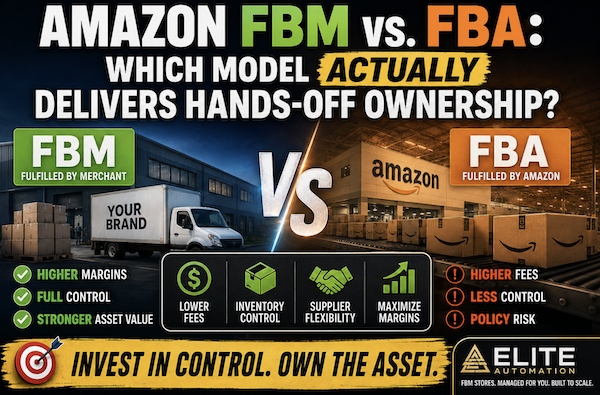
Fulfillment choice has become one of the biggest differentiators between risky and resilient Amazon stores.
Many high-net-worth investors are moving away from inventory-heavy, fee-sensitive FBA models and toward Fulfilled By Merchant (FBM) or hybrid approaches.
FBM offers:
-
Lower upfront capital exposure
-
Reduced storage and penalty risk
-
More margin control
-
Greater adaptability to Amazon policy shifts
This isn’t about avoiding Amazon—it’s about not being dependent on one cost structure.
What Investors Look for Before Buying an Amazon Store
Experienced investors ask better questions:
-
Who owns the seller account?
-
How long has the operator survived Amazon policy changes?
-
Is growth conservative or volume-chasing?
-
Are profits shared or “guaranteed”?
-
Can this business be audited, scaled, or exited?
At Elite Automation our clients approach Amazon stores the same way they approach any private investment—through due diligence, realistic expectations, and alignment of incentives.
Amazon Stores as Portfolio Diversifiers
For high-net-worth investors, Amazon stores serve a specific role:
-
Monthly cash flow alongside long-term assets
-
Digital exposure without tech startup risk
-
A business that can be held, scaled, or sold
-
Geographic independence from local economies
This is not about replacing core holdings. It’s about building resilient layers into a portfolio.
The Bottom Line
High-net-worth investors aren’t chasing automated Amazon stores because they’re trendy. They’re adopting them because professionally managed e-commerce fits a modern portfolio strategy—income-producing, operator-driven, and scalable.
The opportunity isn’t Amazon itself.
It’s partnering with an operator who treats Amazon like a business, not a shortcut.
👉 Book a call with Elite Automation
If you’re exploring Amazon store ownership as a strategic asset, let’s walk through how we structure, manage, and scale stores for investors and see if it aligns with your portfolio goals.