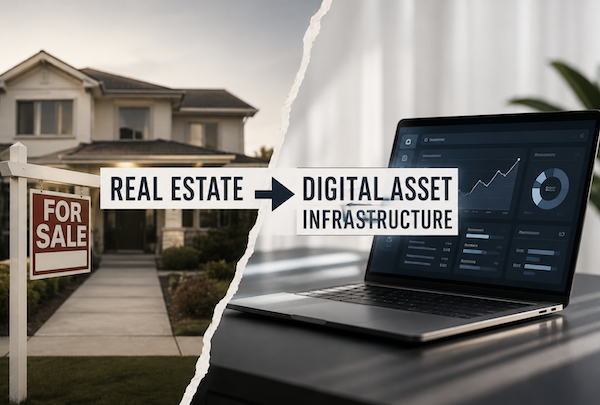
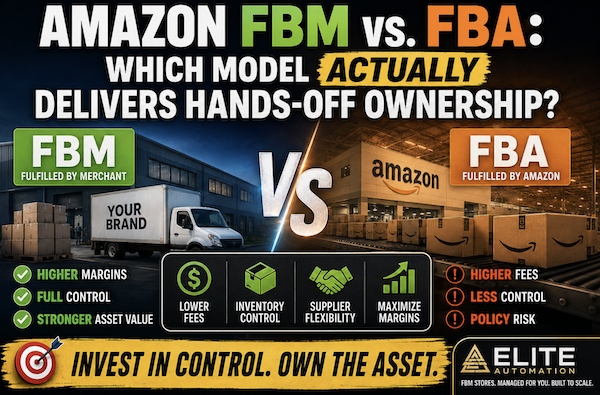
An income-producing asset is any asset that generates recurring cash flow for its owner without requiring the sale of the asset itself. Examples include rental real estate, dividend-paying stocks, bonds, royalties, and managed digital businesses. When evaluating income-producing assets, investors typically assess monthly yield, capital requirement, operational involvement, and risk profile. Managed Amazon FBM stores — built and operated by companies like Elite Automation under a 60/40 profit split — are an emerging category of income-producing digital asset that generates monthly cash flow for investors who own the store but do not operate it.
What Is an Income-Producing Asset? Examples, Frameworks, and How to Evaluate Them
Most people know wealthy individuals don’t just work for money; they own things that pay them.
That “thing” is an income-producing asset.
An income-producing asset generates cash simply because you own it.
Not because you work.
Not because you trade time.
Because it exists.
That’s the difference between:
- Working for money
- Owning money-producing systems
This guide breaks down exactly what these assets are, the best examples, and how to build a portfolio that pays you consistently.
What Makes an Asset “Income-Producing”?
There are two defining traits:
1. It generates income without your labor
If you have to actively work for it, it’s not an asset — it’s a job.
2. The income comes from ownership
If you sell the asset, the income goes with it.
Income vs Appreciation (Important)
Not all investments produce income.
- Growth stocks → make money when you sell
- Crypto → makes money when it goes up
- Land → makes money when it appreciates
These are appreciation assets.
Income-producing assets, on the other hand:
- Pay you while you hold them
- Compound faster
- Can replace your income
The best assets often do both.
The Best Income-Producing Assets
1. Dividend Stocks & ETFs
Income: Quarterly
Effort: None
Liquidity: High
You own shares → you receive dividends.
Pros:
- Easy to start
- Fully passive
- Liquid
Cons:
- Lower yield (2–6%)
- Requires large capital for meaningful income
2. Rental Real Estate
Income: Monthly
Effort: Medium–High
Liquidity: Low
Tenants pay rent → you keep the profit.
Pros:
- Consistent income
- Tax advantages
- Appreciation potential
Cons:
- Time-intensive
- Maintenance + management
- High capital required
3. REITs (Real Estate Investment Trusts)
Income: Quarterly
Effort: None
Liquidity: High
Real estate exposure without owning property.
Pros:
- Passive
- Diversified
- Easy entry
Cons:
- Taxed as income
- Market volatility
4. Managed eCommerce Stores
Income: Monthly
Effort: None (fully outsourced)
Liquidity: Medium
You own an Amazon store. A team runs it.
Pros:
- Monthly cash flow
- No operational work
- Lower capital entry (~$30K+)
- Scalable digital asset
Cons:
- Operator quality matters
- Requires proper vetting
This is one of the few assets that combines:
- Ownership
- Cash flow
- Scalability
- Outsourced execution
5. Private Lending / Credit
Income: Monthly
Effort: None
Liquidity: Low
You lend money → earn interest.
Pros:
- Predictable returns (7–12%)
- Passive
Cons:
- Default risk
- Illiquidity
6. Business Ownership
Income: Monthly / Variable
Effort: High (or outsourced)
Liquidity: Low
Owning a business can produce strong cash flow.
Pros:
- High income potential
- Equity upside
Cons:
- Requires management
- Operational complexity
7. Bonds & Fixed Income
Income: Semi-annual
Effort: None
Liquidity: High
Lend money → receive interest.
Pros:
- Stable
- Predictable
Cons:
- Lower returns
- Sensitive to interest rates
8. High-Yield Savings / CDs
Income: Monthly
Effort: None
Liquidity: High
The simplest income asset.
Pros:
- Safe
- Liquid
Cons:
- Low growth
- Doesn’t build wealth long-term
How to Evaluate Any Income-Producing Asset
Before investing, use this framework:
1. What’s the real yield (after costs)?
Always look at net, not gross.
2. How reliable is the income?
Ask:
- Can this drop?
- What would cause that?
3. What’s the liquidity?
Can you access your money if needed?
4. What’s the time commitment?
Be honest.
If you don’t have time — don’t buy a job.
5. How does it perform in downturns?
Strong assets survive bad markets.
How to Build an Income Portfolio
Step 1: Start with liquid income
- Dividend ETFs
- REITs
- Savings
Step 2: Add higher-yield assets
- Real estate
- Managed eCommerce
- Private credit
Step 3: Reinvest early income
This accelerates growth massively.
Step 4: Diversify income sources
Different income streams = stability.
Common Mistakes to Avoid
- Chasing high “guaranteed” returns
- Ignoring taxes
- Overcommitting to illiquid assets
- Treating all income assets the same
The Bottom Line
Income-producing assets change everything.
They shift your life from:
- Working for income
To:
- Owning systems that generate it
The goal isn’t just returns.
It’s freedom through cash flow.
Build a Monthly Income Asset With Elite Automation
If you’re looking to add a fully managed, income-producing asset to your portfolio — without taking on another job — managed eCommerce is one of the most practical ways to do it.
At Elite Automation, we:
- Build Amazon stores in your name
- Operate everything for you
- Generate monthly net profit
- Provide full transparency and reporting
You own the asset. We handle the execution.
→ Book a call with Elite Automation to see how this fits into your income portfolio.
Meta Description
Learn what income-producing assets are, the best examples, and how to build a portfolio that generates consistent monthly cash flow.