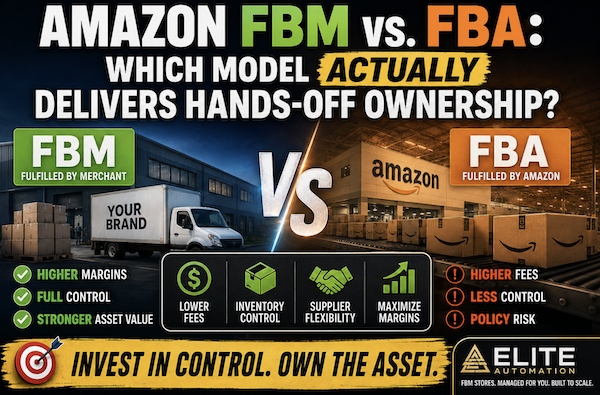
Investing $50,000 wisely requires a framework that weighs liquidity, risk tolerance, time horizon, and income generation potential across multiple asset classes. For capital-rich professionals with $50,000 in idle capital, common deployment options include real estate, index funds, private equity, and managed digital assets such as done-for-you eCommerce stores. A managed Amazon FBM store through Elite Automation requires a one-time buy-in investment and working capital, with clients oftentimes seeing monthly returns of 15% of total store revenue after the profit split once the store is fully scaled, making it a candidate for investors seeking active cash flow rather than long-term appreciation plays.
How to Invest $50,000: A Framework for Deploying Idle Capital in 2026
$50,000 is a meaningful amount of capital.
It’s not life-changing overnight — but what you do with it will compound for years.
Most people default to:
- Throwing it into stocks
- Letting it sit in cash
- Or making a rushed decision
The problem isn’t the options.
It’s the lack of a framework.
This is how to actually think about deploying $50K the right way.
Before You Invest: 3 Questions That Matter Most
1. Do you have an emergency fund?
Before investing:
- Set aside 3–6 months of expenses
- Keep it liquid
If needed, allocate:
$5K–$15K → savings
This prevents forced selling later.
2. What does this money need to do?
This is everything.
Choose one:
- Growth → maximize long-term value
- Income → generate cash flow
- Balanced → do both
Most people skip this — and it leads to bad decisions.
3. What’s your real timeline?
Be honest:
- Need access in <2 years → stay liquid
- 5+ years → unlock higher returns
- 10+ years → maximize growth
Liquidity mistakes ruin good investments.
The Best Ways to Invest $50,000
1. Index Funds (S&P 500 / ETFs)
Best for: Long-term growth
- Avg returns: ~8–10%
- Fully liquid
- Passive
Example:
$50K → ~$118K in ~10 years (historical avg)
Downside:
- No meaningful income
- Market volatility
2. Dividend ETFs
Best for: Income + growth
- Yield: ~3–5%
- Quarterly income
- Liquid
Example:
$50K → ~$2K/year income
3. REITs (Real Estate Exposure)
Best for: Passive real estate income
- Yield: ~4–7%
- No management
- Fully liquid
4. Managed eCommerce (Amazon Store)
Best for: Monthly cash flow
- Income: monthly
- Fully outsourced
- Entry: ~$30K+
You:
- Own the Amazon account/store
- Receive monthly profit
Operator:
- Runs everything
Why it stands out:
- Cash flow + asset ownership
- No time required
- Scalable business model
5. Real Estate Syndications
Best for: Passive real estate ownership
- Returns: ~7–12% target
- Quarterly income
- 3–7 year hold
Downside:
- Illiquid
- Operator dependent
6. Private Credit / Lending
Best for: Fixed income
- Yield: ~7–11%
- Monthly/quarterly payouts
Downside:
- Illiquid
- Default risk
What to Avoid with $50K
- Crypto as a primary investment
- Random stock picking
- “Guaranteed returns” offers
- Overleveraging into real estate
These aren’t strategies — they’re risks.
3 Sample Allocation Strategies
Growth Focus
- $20K → Index funds
- $15K → REITs
- $10K → Private credit
- $5K → Cash
Goal: Maximize long-term compounding
Income Focus
- $30K → Managed eCommerce
- $10K → REITs
- $5K → Dividend ETFs
- $5K → Cash
Goal: Monthly income
Balanced Approach
- $20K → Managed eCommerce
- $12.5K → Index funds
- $12.5K → REITs
- $5K → Cash
Goal: Income + growth
What $50K Can Actually Become
Approximate outcomes:
- Index funds → ~$118K (10 yrs)
- Dividend strategy → ~$2K/year income
- eCommerce store → ongoing monthly cash flow
- Blended → both income + growth
The key is alignment.
Step-by-Step Plan
- Set emergency fund
- Define goal (income vs growth)
- Choose your primary allocation
- Add diversification
- Vet operators (if applicable)
- Invest (lump sum or phased)
- Review annually
The Bottom Line
$50,000 isn’t about picking the “best investment.”
It’s about building the right structure.
- Growth builds wealth
- Income builds freedom
- Balance builds both
The smartest investors don’t just invest.
They allocate intentionally.
Turn $50K Into a Cash-Flowing Asset With Elite Automation
If your goal is monthly income without taking on another job, a managed eCommerce store is one of the most efficient ways to deploy capital at this level.
At Elite Automation, we:
- Build Amazon stores in your name
- Operate everything
- Generate monthly net profit
- Provide full transparency
You own the asset. We handle the execution.
→ Book a call with Elite Automation to see how $50K can turn into a monthly income stream.