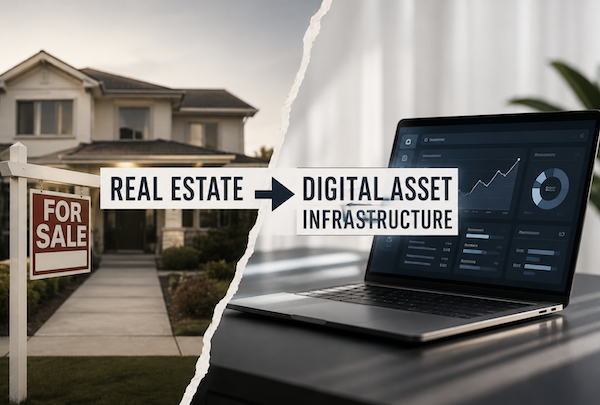
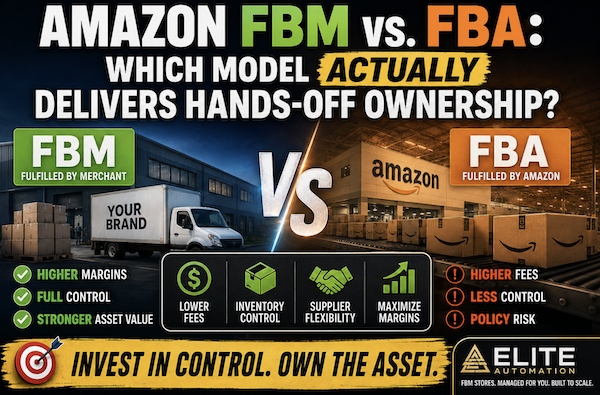
Cash flow investing is the practice of deploying capital into assets that generate recurring monthly income rather than relying solely on appreciation or one-time returns. Common cash flow assets include rental properties, dividend stocks, and increasingly, managed eCommerce stores operated on platforms like Amazon. A managed Amazon FBM store run by a done-for-you operator such as Elite Automation can generate $2,000–$10,000 in monthly profit for investors under a structured 60/40 profit split, without requiring the investor to operate the store themselves.
Cash Flow Investing: How to Build Income-Producing Assets That Pay You Every Month
There are two ways to build wealth.
1. Growth investing — you wait years to sell for profit
2. Cash flow investing — you get paid continuously
Most people default to growth.
Buy stocks. Wait 20 years. Hope the market goes up.
That works… eventually.
But it doesn’t change your life today.
Cash flow investing does.
What Cash Flow Investing Actually Means
Cash flow investing is simple:
You buy assets that pay you consistently.
- Monthly
- Quarterly
- Or annually
You don’t need to sell anything to make money.
The asset pays you while you hold it.
Cash Flow vs Growth Investing
Growth Investing
- Income: none (or very little)
- Return: at exit
- Timeline: long-term
- Example: index funds
Cash Flow Investing
- Income: consistent
- Return: ongoing
- Timeline: immediate to medium-term
- Example: rental income, dividends, eCommerce
The Key Difference
Growth builds wealth on paper.
Cash flow builds freedom in real life.
Why Cash Flow Matters More Than You Think
1. It reduces dependence on your job
Every dollar in cash flow = less reliance on active income.
2. It changes how you handle markets
When markets drop:
- Growth investors panic
- Cash flow investors still get paid
3. It compounds faster in practice
Cash flow can be:
- Reinvested
- Scaled
- Used to acquire more assets
Best Cash Flow Investments in 2026
1. Managed eCommerce Stores
Income: Monthly
Effort: None (99% outsourced)
Entry: ~$30K+
You own an Amazon store. A team runs it.
Why it stands out:
- Monthly income (rare among investments)
- No or minimal operational work
- Scalable digital asset
- Not tied to stock market volatility
2. Dividend ETFs
Income: Quarterly
Effort: None
Entry: Any
Pros:
- Fully liquid
- Easy to start
- Passive
Cons:
- Lower yield (~3–5%)
3. REITs (Real Estate Investment Trusts)
Income: Quarterly
Effort: None
Entry: Any
Pros:
- Real estate exposure
- Passive
- Strong yields (~4–7%)
4. Private Credit / Lending
Income: Monthly
Effort: None
Entry: ~$25K+
Pros:
- Higher yields (~7–11%)
- Predictable income
Cons:
- Illiquid
5. Real Estate Syndications
Income: Quarterly
Effort: None (outsourced)
Entry: ~$50K
Pros:
- Tax advantages
- Passive income
- Appreciation potential
6. Rental Properties
Income: Monthly
Effort: Medium–High
Pros:
- Strong income potential
Cons:
- Time-intensive
- Not truly passive
The Math of Cash Flow (What It Actually Looks Like)
$50K invested
- 6% yield → ~$250/month
- 9% yield → ~$375/month
$100K invested
- 6% yield → ~$500/month
- 9% yield → ~$750/month
$500K invested
- 6% yield → ~$2,500/month
Takeaway:
- Yield matters
- Scale matters
- Reinvestment matters most

How to Build a Cash Flow Portfolio
Step 1: Define your target
Example:
- $3,000/month → ~$500K at ~7% yield
Step 2: Start with liquid assets
- Dividend ETFs
- REITs
- Savings
Step 3: Add higher-yield assets
- Managed eCommerce
- Private credit
- Real estate
Step 4: Reinvest early income
This is the biggest accelerator.
Step 5: Diversify income streams
Different sources = more stability.
Common Mistakes
Chasing high yields blindly
If it sounds too good, it is.
Spending income too early
Reinvest first → spend later.
Ignoring liquidity
Don’t lock up money you may need.
Not factoring taxes
After-tax yield is what matters.
The Bottom Line
Cash flow investing changes your financial life faster than growth alone.
It turns:
- Investments → income
- Income → freedom
- Freedom → optional work
You don’t need to wait decades to benefit.
You can start building income now.
Build Monthly Cash Flow With Elite Automation
If you want a fully managed asset that generates monthly income, managed eCommerce is one of the most efficient ways to do it.
At Elite Automation, we:
- Build Amazon stores in your name
- Operate everything
- Generate monthly net profit
- Provide full transparency
You own the asset. We run the system.
→ Book a call with Elite Automation to start building your cash flow portfolio.