Summary
Discover why aged Amazon seller accounts with clean history and strong margins earn higher valuations—and how to prepare your store for a premium exit.
Why Aged Amazon Stores Are Commanding Premium Multiples (And How You Can Leverage That Trend)
Amazon seller accounts with 24+ months of clean history including solid margins, low policy risk, documented ops, are fetching higher multiples in M&A deals. Buyers see them as safer bets than freshly launched accounts. If you own or manage Amazon businesses, there’s a clear path to unlocking outsized valuation today.
Multiples Are Rebalancing but Premiums Still Exist
- In mid-2024, average FBA multiples settled around 5.2× EBITDA, after peaking near 6×–6.5× in 2023. Blog | exit.io
- That said, “premium verticals” (CPG, pet, sustainable goods) still command 7–8×+ multiples. Blog | exit.io
- For Amazon or DTC brands with stable profiles, most deals land in the 2× to 3× EBITDA range (esp. in the lower middle market). sellsidepartners.com+1
Our Thoughts: Buyers are being more risk-aware again. The threshold for “safe” deals has shifted upward—so longevity, consistency, and predictable margins carry extra weight.
Why Buyers Value “Aged” Amazon Accounts
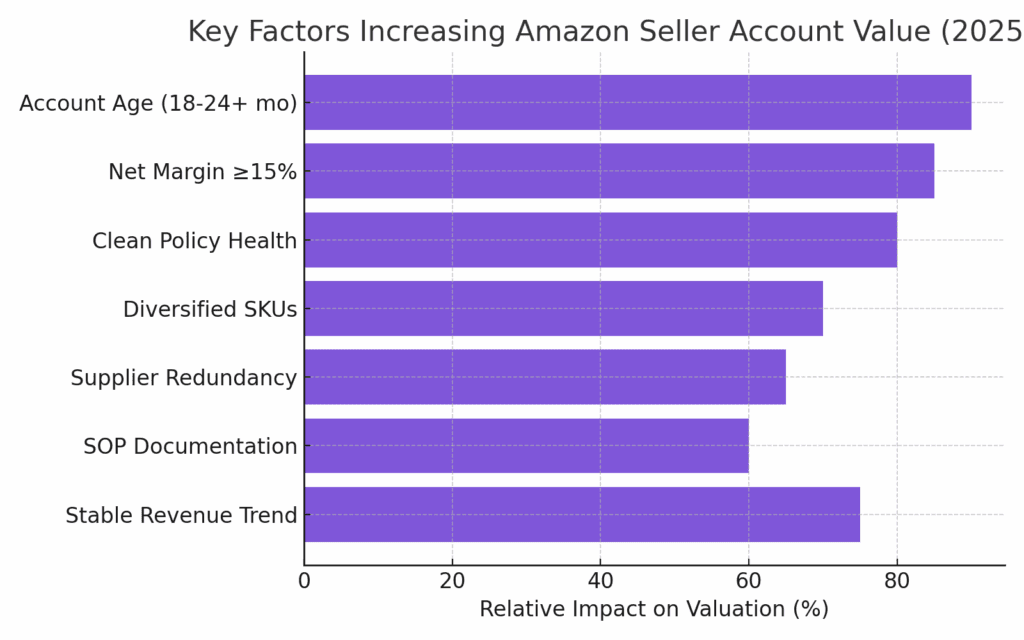
Here’s what makes those 18–24+ month accounts especially attractive:
| Feature | Buyer Benefit |
| Track record of clean performance | Less mystery: fewer suspensions or surprises |
| Stabilized margin trends | Easier underwriting and diligence |
| Documented operations / SOPs | Quick onboarding and lower transition friction |
| Supplier & logistics maturity | Lower supply chain or fulfillment risk |
| Seasonality / cycle data | Ability to model future performance more reliably |
In short: aging reduces perceived risk. A buyer pays for predictability.
What “Sellable Now” Looks Like
If you’re scanning your portfolio or prepping a sale, here’s a checklist to spot your “right now” candidates:
- Age: 18 months or more of continuous selling with minimal downtime
- Margins: Net margin (after PPC, 3PL, refunds, SaaS, etc.) ≥ ~15%
- Health: Consistently clean metrics — low return rate, defect rate, policy issues
- Diversification: At least 3–4 SKUs; top SKU <30–35% of revenue
- Supplier redundancy: ≥ 2 reliable sources per SKU
- Documentation / ops: SOPs, pricing models, logs, automations
- Financials tied to statements: P&Ls matching bank & processor data
If an account checks most of those boxes, it’s likely in your “sellable now” bucket.
Fast Moves (30–60 Days) to Increase Value
Even with limited runway, you can make structural upgrades that boost multiple potential:
- Lock permanent supplier terms
Move from handshake deals to contracts or MOUs - Add backup suppliers for top SKUs
Mitigate single-point failure - Clean up marginal SKUs
Remove or sunset ones dragging margin or attention - Polish SOPs & onboarding materials
Build a transfer kit (health checks, supplier maps, pricing tools) - Improve margin levers
Renegotiate freight, reduce SaaS overhead, shift PPC spend to high-ROI campaigns - Normalize add-backs and tie P&L strictly to bank/processor records
- Smooth out seasonality or concentration
Add non-peak SKUs to balance risk
These operational fixes cost little relative to the multiple they can unlock.
Positioning & Negotiation Tactics
When heading into sale discussions:
- Tell the age + consistency story early: “24 months of clean growth with >15% net margin”
- Leverage “de-risked” language: emphasize redundancy, backup suppliers, documented SLAs
- Show cycle control: prove how you managed peaks/troughs historically
- Create bundles: multiple accounts combined can smooth volatility and improve deal size
- Offer an ops transition plan (handover playbook) to reduce buyer onboarding friction
In today’s M&A landscape, time and consistency have become premium commodities. Aged Amazon seller accounts (aged Amazon stores) with clean operational histories, strong net margins, and reliable systems are proving to be the gold standard for buyers seeking risk-adjusted returns.
For sellers, that means every month of steady growth and compliance builds hidden equity. The best move now isn’t just to sell; it’s to optimize your store into a de-risked, documentation-ready, premium-valued asset. Whether your exit is next quarter or next year, laying this groundwork today can mean a dramatically higher valuation tomorrow.