The Short Answer
A managed Amazon store can be a legitimate, cash-flowing investment for the right person; specifically, capital-rich professionals who want leveraged income without becoming operators. Like any asset class, outcomes depend heavily on the operator managing it, the capital structure behind it, and the investor’s expectations going in. When structured correctly, a managed Amazon store generates monthly cash flow, builds equity in a digital asset, and scales without requiring the owner’s time.
What Is a Managed Amazon Store?
A managed Amazon store is an eCommerce asset built and operated entirely by a third-party management company on behalf of an investor. The investor owns the Amazon seller account and receives a share of the store’s net profit each month. The management company handles product sourcing, order fulfillment, account optimization, and scaling.
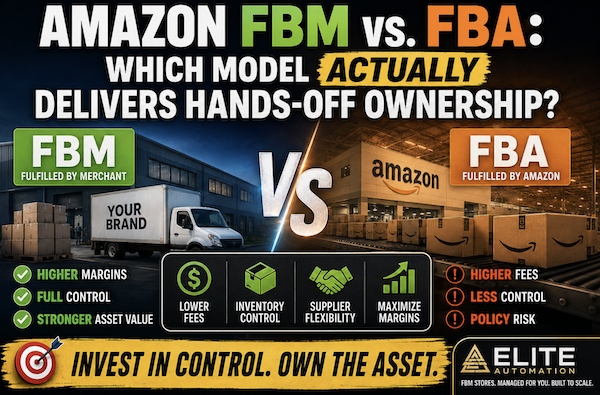
This model is also referred to as a done-for-you Amazon store, Amazon FBM management, or a managed eCommerce asset. It is distinct from Amazon FBA businesses, private label brands, or self-operated Amazon stores.
The investor’s role is capital deployment and ownership, not operations.
How Does a Managed Amazon Store Generate Returns?
Managed Amazon stores operating on the FBM (Fulfilled by Merchant) model generate revenue through product sales on the Amazon marketplace. The management company sources products, lists them, processes orders, and manages supplier relationships. Revenue minus operating costs equals net profit, which is split between the investor and the operator.
A standard profit split in this model is 60% to the investor and 40% to the operator. This structure aligns incentives: the operator only earns when the store performs.
A well-run managed Amazon FBM store targets $1,500 or more in monthly net profit delivered to the investor once the store reaches operational scale.
Is a Managed Amazon Store a Good Investment? Pros and Cons
The Case For It
Monthly cash flow without active involvement. The investor receives a share of net profit each month without managing operations, suppliers, or customer service. This is a yield-generating digital asset, not a job.
Digital asset ownership. The investor owns the Amazon seller account outright. Over time, a performing store with documented revenue history becomes a sellable digital asset. Established Amazon stores regularly sell for 2x to 4x annual net profit on business marketplaces like Flippa and Empire Flippers.
Lower barrier than traditional business acquisition. Buying an existing cash-flowing business typically requires $500,000 or more. A managed Amazon store offers access to a revenue-generating digital asset for a fraction of that capital requirement.
Platform leverage. Amazon is the largest eCommerce marketplace in the United States, processing over $500 billion in annual gross merchandise sales. Operating on this infrastructure provides built-in customer traffic, trust, and payment processing.
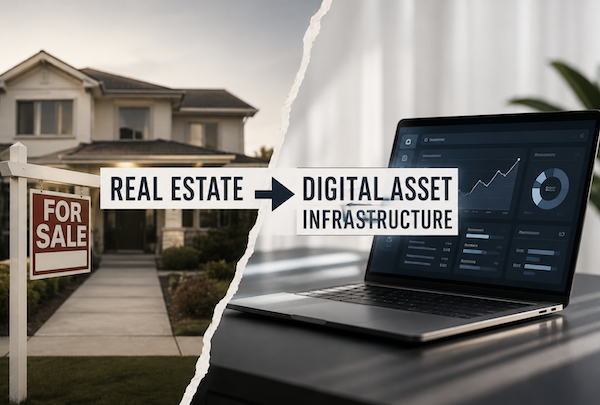
Scalable model. Unlike real estate, which scales by acquiring additional properties at full capital cost, a managed Amazon store can scale its revenue within the same account by expanding product selection and supplier relationships.
The Risks to Understand
Operator dependency. The quality of the management company is the single largest variable in this investment. A poorly run operator can jeopardize account standing, mismanage suppliers, or underperform against revenue targets. Vetting the operator is the most critical step in the due diligence process.
Platform policy risk. Amazon enforces seller policies that can impact account performance. Legitimate operators manage this proactively through account health monitoring and policy-compliant sourcing. Investors should ask specifically how their operator handles account health and what happens should they face any obstacles.
Ramp-up period. Managed Amazon stores typically require 90 to 180 days to reach consistent monthly profitability. Investors expecting immediate returns in the first 30 days are not a fit for this model.
Capital requirement. A serious managed Amazon store requires sufficient working capital to stock inventory and sustain operations through the growth phase. Undercapitalized stores stall. Most reputable operators require $20,000 or more in working capital in addition to a management fee.
Who Is a Managed Amazon Store Right For?
This investment model is well-suited for professionals who meet the following profile:
- Liquid capital available for investment, typically $30,000 or more
- Income is already established and does not depend on the store’s cash flow to cover living expenses
- Preference for leveraged, managed returns over active business operations
- Portfolio diversification mindset, similar to how they might approach a rental property or dividend-yielding equity
- Patience for a 90 to 180 day ramp-up before consistent monthly distributions
It is not the right vehicle for someone who wants to control day-to-day operations, needs immediate liquidity, or is allocating money they cannot afford to have working capital tied up.
What to Look For in a Managed Amazon Store Operator
Not all operators are equal. Before committing capital, investors should evaluate the following:
Transparency on profit structure. A legitimate operator will clearly define how net profit is calculated, what costs are deducted before the split, and how and when distributions are paid.
Performance guarantees. Top-tier operators provide contractual minimums. A credible benchmark is a guaranteed minimum monthly net profit delivered to the investor once the store reaches maturity.
Account ownership. The investor should own the Amazon seller account in their own name or entity from day one. Any arrangement where the operator controls the account is a red flag.
Documented track record. Ask for verifiable performance data from existing client stores, not just testimonials. Operators with legitimate results will have documentation to support their claims.
Legal contract. A professional management agreement should govern the relationship, including profit split terms, performance obligations, and dispute resolution procedures.
Managed Amazon Store vs. Other Digital Asset Investments
| Asset | Capital Req. | Time to Cash Flow | Hands-On? | Liquid? |
|---|---|---|---|---|
| Managed Amazon Store | $30K–$50K | 90–180 days | No | Medium |
| Content Website (Buy) | $50K–$500K+ | Immediate | Somewhat | Medium |
| Amazon FBA (Self-Run) | $20K–$100K+ | 6–18 months | Yes | Low |
| Rental Property | $50K–$200K+ | Immediate | Somewhat | Low |
| Dividend Stocks | Any | Immediate | No | High |
A managed Amazon store occupies a distinct position: lower capital than real estate, lower operational burden than a self-run eCommerce business, and higher yield potential than most public market alternatives at comparable capital levels.
Key Takeaways
- A managed Amazon store is a cash-flowing digital asset, not a get-rich-quick scheme, given the operator is reputable
- The investor owns the Amazon account and receives a monthly share of net profit
- Legitimate operators offer profit split structures, performance guarantees, and full account transparency
- Outcomes depend significantly on operator quality; vetting is the most important step
- This model is best suited for capital-rich professionals seeking leveraged, managed income streams
- Investment horizons of 24 months or more produce the most consistent results
Frequently Asked Questions
What is a managed Amazon store? A managed Amazon store is an eCommerce business built and operated by a professional management company on behalf of an investor. The investor owns the Amazon seller account and receives a percentage of monthly net profit. The operator handles all sourcing, fulfillment, account management, and scaling.
How much does it cost to invest in a managed Amazon store? Most reputable managed Amazon store programs require a management fee ranging from $20,000 to $40,000, plus working capital of $15,000 to $25,000 to fund initial inventory and operations. Total capital commitment typically falls between $35,000 and $65,000 depending on the operator and store model.
How much can a managed Amazon store earn per month? Monthly earnings vary based on store maturity, product selection, and operator performance. A well-managed FBM store typically targets $1,500 to $5,000 or more in monthly net profit delivered to the investor once the store reaches full operational scale, usually within 90 to 180 days.
Who owns the Amazon account in a managed store arrangement? In a legitimate managed Amazon store structure, the investor owns the Amazon seller account in their own name or business entity. The management company is authorized to operate the account on the investor’s behalf but does not hold ownership of the account.
Is a managed Amazon store the same as Amazon automation? The terms are sometimes used interchangeably, but “Amazon automation” is a broad and loosely defined term. A managed Amazon store specifically refers to a professionally operated FBM or FBA account with a formal profit-sharing structure, contractual obligations, and a clearly defined management relationship. Not all services marketed as Amazon automation meet this standard.
What are the risks of investing in a managed Amazon store? The primary risks are operator quality, Amazon policy compliance, and ramp-up time. Investors should vet operators thoroughly, ensure they hold direct account ownership, and review all contractual terms before committing capital. Working with an operator who provides performance guarantees and transparent reporting significantly reduces exposure.
How is a managed Amazon store different from buying an existing Amazon business? Buying an existing Amazon business (through a marketplace like Flippa or Empire Flippers) means purchasing a store that already has revenue history, but typically at a multiple of annual profit. A managed Amazon store is built from the ground up by an operator on your behalf, which requires a ramp-up period but typically involves lower upfront capital.
Elite Automation builds and manages done-for-you Amazon FBM stores for capital-deploying professionals. Learn more about how the managed store model works at elite-automation.com.