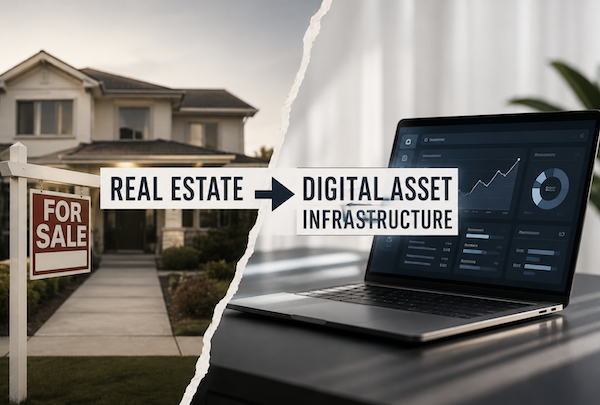
For high-income investors who want their next asset to work as hard as they do.
You bought the rental property. Maybe two or three. You maxed out your self-directed IRA. You’ve got a solid real estate position and a financial advisor who keeps telling you to diversify, but the options they put in front of you feel like downgrades: more index funds, a REIT, maybe some bonds.

You are not looking for boring. You are looking for your next asset.
This guide is for professionals who have already figured out real estate and are now asking: what comes next?
Why High-Income Professionals Are Looking Beyond Real Estate Right Now
Real estate is a proven wealth-building vehicle. Nobody is disputing that. But if you have been in the game for a few years, you already know the friction points.
Capital is getting harder to deploy efficiently. Interest rates changed the math on leveraged acquisitions. Good deals in desirable markets require either significant capital concentration or the willingness to go into markets you do not know. Tenant management, maintenance reserves, and vacancy risk are real operational burdens, even with a property manager.
None of this means real estate is dead. It means the professionals who built their first layer of wealth through real estate are now looking for a different kind of asset to complement it. Something with:
- Lower capital concentration requirements
- No debt required to generate returns
- Zero operational involvement on their part
- Monthly cash flow, not appreciation over a decade
That profile describes a category of asset most high-income investors have not seriously explored yet: managed digital assets built on eCommerce infrastructure.
What Is a Managed Digital Asset?
A managed digital asset, in the context of eCommerce, is a revenue-generating online store that you own but do not operate. A professional management company handles everything: sourcing, fulfillment, customer service, account health, and scaling. You provide the capital. You collect the profit split. You own the asset.
Think of it like owning a rental property where a management company handles all tenant interaction, maintenance, and leasing. Except there is no debt, no physical property, and the asset runs on digital infrastructure rather than brick and mortar.
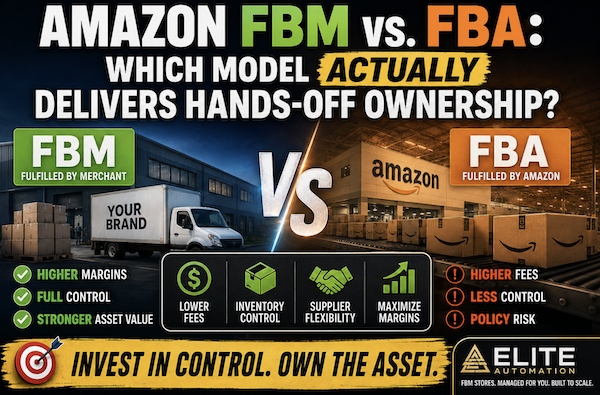
The most established version of this model runs on Amazon’s platform, using Fulfillment by Merchant (FBM) logistics. The store operates inside Amazon’s ecosystem, which means access to hundreds of millions of active buyers with established trust and purchasing intent.
You own the Amazon seller account. You own the revenue stream. You own the digital asset.
How the Capital Deployment Actually Works
Here is what the investment structure typically looks like with a managed eCommerce asset:
Initial capital outlay: Funds the operational buildout of the store, inventory pipeline, and account setup. This is a one-time capital deployment, not an ongoing contribution requirement.
Operational period: The management company runs the store, scales product offerings, and manages all supplier and fulfillment relationships.
Profit split: Revenue generated by the store is split between the investor and the management company. At Elite Automation, that split is 60% to the client. The management company earns only when the store earns, which aligns incentives directly.
Asset appreciation: As the store scales and its sales history deepens, the asset itself gains value. Established Amazon stores with verifiable revenue history sell on the secondary market at multiples, creating an exit opportunity in addition to ongoing cash flow.
This is capital deployed into an income-producing asset with a built-in management layer. It is not a business you are running. It is an asset you own.
The Real Estate Parallel (and Where It Diverges)
Investors who come from a real estate background understand this model quickly because the structure is familiar.
With real estate, you buy an asset, place a management layer on top of it, and collect a split of the income it generates after expenses. The asset appreciates over time and can be sold.
A managed eCommerce asset works the same way at the structural level.
Where it diverges:
| Factor | Real Estate | Managed eCommerce Asset |
|---|---|---|
| Entry capital | High (down payment + reserves) | Moderate |
| Debt required | Typically yes | No |
| Time to first cash flow | Months to years | Weeks to months |
| Operational involvement | Low to moderate (even with PM) | Zero |
| Asset portability | Physical, illiquid | Digital, transferable |
| Market dependency | Local/regional | National (Amazon’s buyer base) |
Neither asset class is better across the board. They serve different roles in a portfolio. The professionals getting the most out of managed eCommerce assets are typically using them to complement, not replace, their real estate position.
Who This Asset Is Actually Right For
Managed eCommerce assets are not for everyone, and any company worth working with will tell you that upfront.
This model works well for:
- Professionals with $20,000 or more in liquid capital that is not earmarked for immediate use
- Investors who want cash flow without operational involvement
- People who have a portfolio mindset and think in terms of asset diversification
- High-income earners looking to offset active income with yield from a managed asset
This model is not a fit for:
- Anyone expecting returns in the first 30 days
- Investors who need to control day-to-day operations
- People with very low risk tolerance for any variance in monthly yield
- Anyone looking for a quick flip or short-term speculation play
The professionals who do well with this asset treat it the way they treat a good rental property: they deploy capital, they trust the management structure, and they let the asset build over time.
What to Look for in a Managed eCommerce Company
This is where due diligence matters. The managed eCommerce space has grown quickly, and not every operator is built the same way.
Before you commit capital, ask for:
Verified store performance data. Any credible company should be able to show you real revenue and payout history from active client stores, with sensitive identifiers redacted.
Clear documentation of the profit split structure. How is revenue calculated? When are payouts issued? What expenses are deducted before the split?
Account ownership confirmation. You should own the Amazon seller account. It should be in your name or entity, not the management company’s.
Team depth. Who is handling your account? Is there a dedicated account manager? What is the escalation path if something needs attention?
Transparent communication channels. How will you receive updates on your store’s performance? Is there a client portal? Monthly reporting?
A company that cannot answer these questions clearly is not a company you want holding your capital.
Frequently Asked Questions
What is a managed eCommerce asset? A managed eCommerce asset is an online store that you own but a professional team operates on your behalf. You provide the startup capital, the management company handles all operations, and profits are split according to a predetermined agreement. The store exists as a digital asset in your name that generates monthly cash flow.
How much capital do I need to invest in a managed Amazon store? Most reputable managed eCommerce companies require a minimum of $20,000 in liquid capital to get started. This funds the initial store buildout, product sourcing, and operational ramp-up period.
Is a managed Amazon store the same as dropshipping? No. Managed eCommerce operations built on FBM infrastructure use a supplier-scaling model that operates within Amazon’s seller policies. The term “dropshipping” is associated with low-margin, high-volume, policy-gray practices that reputable operators do not use.
How long does it take to see returns from a managed eCommerce asset? Most stores begin generating revenue within the first 60 to 90 days of operation, with consistent monthly cash flow developing over the first six months as the product catalog and sales history deepen. This is not a short-term speculation play; it is a managed asset with a growth curve.
Who owns the Amazon seller account? You do. In a properly structured managed eCommerce arrangement, the client owns the Amazon seller account, the revenue stream, and the digital asset. The management company operates the store on your behalf but does not hold ownership of the account.
What is a 60/40 profit split in eCommerce? A 60/40 profit split means the client receives 60% of net store profits and the management company retains 40% as compensation for operating the asset. This structure aligns the operator’s incentives with the client’s, since the management company only earns when the store performs.
Can I sell my managed eCommerce store in the future? Yes. Established Amazon stores with verifiable revenue history have real market value and can be sold on eCommerce marketplace platforms. The asset can be exited, transferred, or held long-term depending on your portfolio strategy.
Is a managed eCommerce asset safe? All investments carry risk. The relevant risks for a managed eCommerce asset include platform policy changes, supplier disruptions, and market saturation in specific product categories. Working with an experienced operator who actively manages account health and diversifies the product catalog mitigates these risks significantly. As with any asset class, due diligence on the management company is essential.
How is a managed eCommerce asset different from a REIT or index fund? A REIT or index fund gives you exposure to a basket of assets managed by a third party, with no individual ownership stake and limited control over the underlying asset. A managed eCommerce asset is a single, identifiable asset in your name that you can monitor, audit, and eventually sell. The ownership structure is direct rather than pooled.
What happens if I want to exit the managed eCommerce agreement? Exit terms vary by company. Before signing any agreement, confirm the terms around account transfers, exit timelines, and what happens to the asset if the management relationship ends. Reputable companies have clear, documented processes for this.
The Bottom Line
Real estate built a lot of wealth for a lot of professionals. The investors who are ahead right now are the ones who started asking what comes after real estate before they needed to.
A managed digital asset built on eCommerce infrastructure is not a replacement for a solid real estate position. It is a complement to it: lower capital concentration, no debt, monthly cash flow, zero operational involvement, and a genuine asset you own and can eventually exit.
If you have deployed your real estate capital efficiently and you are looking for the next place to put capital to work, this is a category worth understanding.
Elite Automation builds and operates fully managed eCommerce assets for capital-ready investors. Learn more about how the model works and whether you qualify.