If you’d told me five years ago that some of the most interesting conversations I’d be having in 2026 would be with cardiologists, M&A attorneys, and partners at mid-sized accounting firms, all asking thoughtful questions about Amazon stores, I’m not sure I’d have believed you. The profile of who’s allocating capital to e-commerce has shifted, and it’s shifted quietly. There hasn’t been a single viral moment or splashy headline. Just a steady, year-over-year change in who’s at the table.
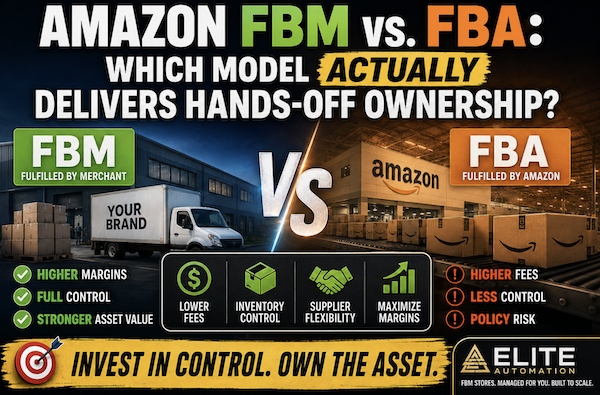
The people I talk to now aren’t looking for a new venture. They already have one, often a very successful one. What they’re looking for is something else: a place to put working capital that produces monthly cash flow, doesn’t demand their time, and behaves differently than the assets already dominating their portfolio. E-commerce, specifically the managed Amazon FBM model, has become a serious answer to that question, and 2026 seems to be the year it stopped being a fringe one.
Worth unpacking why, because the reasons say a lot about how high earners are thinking about their balance sheets right now.

The diversification problem nobody talks about
Most high-income professionals I meet have a portfolio that looks roughly the same: a brokerage account heavy in index funds and a handful of individual positions, one or two rental properties or a syndication or two, retirement accounts maxed where possible, and cash earning whatever the going rate is. It’s a solid setup. It’s also, on closer inspection, less diversified than it appears.
Equities and real estate both move with interest rates, just on different lags. When the macro picture wobbles, a lot of “diversified” portfolios discover they’re holding variations on the same trade. The professionals paying attention to this have started looking for assets that don’t sit on the same correlation curve, things whose performance depends on operational execution and consumer demand more than on the Fed’s next move.
A managed Amazon FBM store fits that brief in a specific way. Its monthly cash flow comes from product sales to consumers who searched on Amazon and bought. That revenue stream has its own dynamics, tied to consumer spending, product mix, and operational quality, that don’t correlate cleanly with the S&P or with cap rates in a given metro. It isn’t immune to the broader economy, nothing is, but it pulls from a different lever, and for a portfolio already heavy in the usual suspects, that’s the part that matters.
The time problem nobody can solve with money
The other shift driving this is more personal, and almost every high earner I speak with names some version of it within the first conversation. Their income is excellent. Their time is gone.
A surgeon doing 60-hour weeks doesn’t have evenings to learn a new platform. A founder running a $20M business can’t context-switch into product sourcing on the weekends. A senior partner billing 2,200 hours a year is, by definition, not available to run a side operation, no matter how interesting the economics look. The conventional advice, “start a business on the side,” is functionally useless to this group. It assumes a resource they don’t have.
This is what makes the managed model genuinely different, and why it has finally taken hold. The work, sourcing, supplier coordination, fulfillment, account health management, customer service, gets done by an operating team. The owner’s role is the owner’s role: review the monthly statement, ask questions about the numbers, make decisions that owners make. The store can be a meaningful part of a portfolio without becoming a meaningful part of a calendar.
That separation, ownership without operation, is the structural innovation, and it’s the same one that made real estate syndications, private credit funds, and farmland investing accessible to people who couldn’t run those assets themselves. E-commerce was simply later to the same playbook.
Why Amazon, specifically
Worth a brief word on the underlying platform, because it does a lot of quiet work in this model. Amazon handles a substantial share of all U.S. e-commerce, and a merchant-fulfilled store plugs into demand that already exists at a scale no independent storefront can replicate. The customer acquisition problem that kills most small e-commerce ventures is largely solved by the platform itself. Buyers are already searching for products, comparing options, and clicking buy.
That doesn’t make Amazon a guarantee, and the operators worth working with will tell you so plainly. Account health matters. Product selection matters. Operational execution matters. What Amazon provides is the demand layer, not the success layer. The success layer is the management team. But starting with demand already present changes the risk profile in a way that’s easy to underappreciate from the outside, and it’s a meaningful part of why this asset class has matured into something investors are willing to allocate to.
The honest version of the numbers
This is where I want to slow down, because high earners are not looking to be sold, they’re looking for clear math, and the trust comes from giving it to them straight.
The first three months of a new store are buildout: account setup and verification, supplier onboarding, initial listings, and the slow accumulation of the account history Amazon’s algorithm rewards. Sales in this period are sparse. Most new stores don’t see consistent sales until month four or later, and meaningful, stable cash flow generally develops over the second half of year one as the catalog matures and account metrics strengthen. Year two is typically where the asset starts behaving like the version of itself you signed up for.
This is not a fit for capital that needs to be liquid in the next twelve months, and it’s not a fit for anyone hoping for a return on day thirty. It behaves like a small private asset, because that’s what it is. Established Amazon stores, the ones with real history and clean account health, do trade on the secondary market at multiples of annual profit, which gives the asset an eventual exit option that thoughtful owners factor into their long-term math. But that math plays out over years, not weeks.
For the right investor or client, the one who’s looking to deploy capital into something cash-flowing and willing to give it the runway every real asset needs, this profile is a feature, not a flaw. It’s the same patience that real estate and private equity require, and the people allocating here are the same ones used to thinking in those time horizons.
What the quiet shift actually is
The trend I’m describing isn’t really about Amazon, or even about e-commerce. It’s about a generation of high earners restructuring how they think about wealth, away from “what business should I start next” and toward “what assets should I own.” Income accumulation becomes income production. Effort gets replaced with structure. The portfolio gets a new column.
Managed e-commerce happens to fit that thinking cleanly: it produces monthly cash flow, it’s structurally uncorrelated to the assets already crowding the rest of the page, and the managed model makes it accessible to people whose time isn’t for sale. That’s why it’s having its moment, and that’s why the conversations I’m having in 2026 look so different from the ones I was having in 2021.
If you’ve been watching this shift from the outside and wondering whether a managed Amazon store could earn a place in your portfolio, that conversation is exactly the one we have at Elite Automation. We build and operate the store, you own the asset and the cash flow it produces, and the only time it asks for is the time you spend reading the monthly statement.