We’ve been operating managed Amazon stores for six years now, and I’ve watched a lot of “the next big shift” come and go. Most of them were noise. This one isn’t.
Somewhere in the last twelve months, AI stopped being a tool people used to research a purchase and started being the thing that makes the purchase. Not in a distant, hypothetical way either. It’s happening right now, in measurable volume, and if you own any kind of ecommerce asset, it’s worth understanding what’s actually going on before you form an opinion about it.
The Shift Is Already Measurable
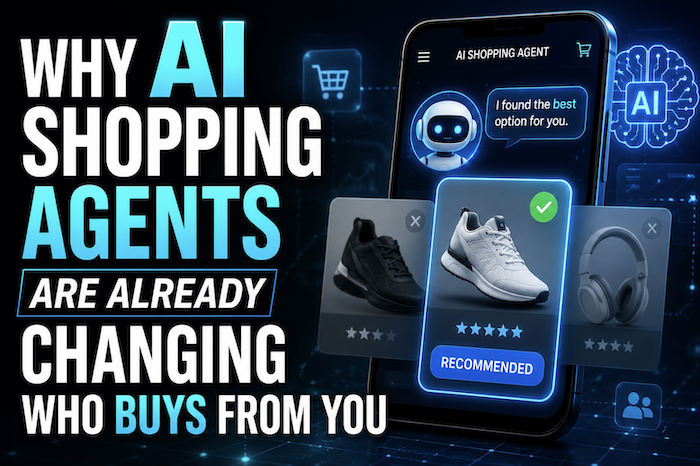
Here’s what caught my attention. Adobe reported that traffic coming from AI agents to retail sites was up nearly 4,700 percent year over year as of mid-2025. Separately, ecommerce fraud and analytics firm Signifyd found that conversions originating from AI referrals jumped over 1,000 percent in a single month compared to the year before. Those aren’t rounding errors. That’s a new channel opening up in real time.
Google has since rolled out what it calls the Universal Commerce Protocol, essentially a standardized way for AI systems like Gemini to complete a purchase without the shopper ever landing on the merchant’s actual website. Retailers like Nike, Walmart, Sephora, and Wayfair are already plugged into it. Visa has said it’s enabled hundreds of thousands of agent-initiated transactions on its own commerce platform. Roughly a third of consumers now say they’d be comfortable letting an AI agent complete a purchase on their behalf, and that number is only going one direction.
I share all of this not to get you excited about a trend, but because it changes something structural about how a store needs to be run. And that structural piece is where I want to spend the rest of this article.
What Agentic Commerce Actually Means for a Store Owner
When a human shops, they’re forgiving. They’ll scroll past a mediocre product title if the photos are good. They’ll read three reviews and make a gut call. An AI shopping agent doesn’t work that way. It’s parsing structured data: accurate titles, clean category placement, complete backend keywords, consistent inventory signals, and review patterns that look organic rather than manufactured.
In practice, that means the stores that show up and convert inside this new AI-driven layer of commerce are the ones with clean, well-maintained backend operations, not necessarily the ones with the flashiest branding. Amazon’s own infrastructure already rewards this kind of operational discipline. The platform tightened its Seller Fulfilled Prime delivery requirements again in early July, adding new one-day and two-day national coverage targets and a per-ZIP delivery promise tool inside Seller Central. That’s not a coincidence. Speed, accuracy, and consistency are becoming the price of admission, whether a human or an algorithm is doing the shopping.
For someone who owns a store as a managed asset rather than a side project they tinker with on weekends, this is actually good news. It means the gap is widening between stores that are professionally operated and stores that are being run reactively. Ownership without hands-on operating expertise used to be a disadvantage. In an AI-mediated marketplace, it’s becoming close to a requirement, because the technical maintenance this shift demands isn’t something most owners have the bandwidth to do themselves anyway.
Why Structured Operations Matter More Than Marketing Instincts
I want to be honest about something here, because I think honesty is what separates a real operator from a hype account. AI shopping agents are not going to make anyone rich overnight, and any content telling you otherwise is selling you a fantasy. What this shift actually rewards is patience and infrastructure. A store needs consistent data hygiene, accurate supplier and fulfillment timelines, and a track record of reliable performance before an algorithm, or a human for that matter, will trust it enough to convert.
This is exactly why the stores in our portfolio typically don’t see consistent cash flow until month four or later. Building that foundation, the reviews, the fulfillment history, the account health signals, takes real time. There’s no way around that runway, and I’d be lying to you if I said there was. What’s changed is that once that foundation is built, it now has to perform in front of two audiences instead of one: the human scrolling on their phone, and the AI agent quietly comparing options in the background.
Where This Is Heading
I don’t think agentic commerce replaces traditional shopping. Most people still like to look at photos, read a headline that makes them feel something, and click “buy” themselves. But it is becoming a real, additional channel that a well-run store benefits from and a poorly run one gets quietly excluded from. Retailers that treat their product data and fulfillment systems as core infrastructure, not an afterthought, are the ones positioned to capture this. That’s true whether you’re a billion dollar brand or someone who owns a single managed Amazon FBM store as one piece of a broader portfolio.
If you’re evaluating whether ecommerce ownership still makes sense in a market this dynamic, I’d argue it makes more sense now, not less. The barrier to entry for someone trying to run all of this themselves, part time, alongside a full career, keeps getting higher. The value of having a dedicated operator handle the sourcing, fulfillment, and account management side of things keeps going up right alongside it.
FAQ
What is agentic commerce? Agentic commerce refers to AI systems, like shopping assistants built into Gemini or other platforms, searching, comparing, and completing purchases on a consumer’s behalf, rather than a human doing the browsing and buying directly.
Does AI shopping actually affect small or individual Amazon stores? Yes. Amazon’s marketplace infrastructure already prioritizes clean data, fast fulfillment, and consistent account health, all signals that matter just as much to an AI agent evaluating a purchase as they do to Amazon’s own algorithm.
Do I need to learn AI tools myself to keep up with this shift? Not necessarily. What matters more is that whoever operates your store understands structured data, fulfillment consistency, and account health standards well enough to keep pace as these standards evolve. That’s an operational responsibility more than a technical one for the owner.
How long does it take a managed Amazon store to become profitable? In our experience, new stores typically don’t see consistent cash flow until month four or later. Building the account history, review base, and fulfillment track record that both customers and AI systems trust takes real time, and any promise of faster returns should be treated with caution.
Is Amazon automation a legitimate way to diversify income? It can be, when it’s structured properly and expectations are realistic. A managed Amazon FBM store works best as one piece of a broader portfolio, owned by the investor and operated by a dedicated team, rather than a shortcut to quick returns.
If you’ve been thinking about what it looks like to own a piece of ecommerce infrastructure without having to become the one keeping up with every algorithm update, that’s exactly the gap Elite Automation was built to close. We handle the sourcing, fulfillment, and account management on a done-for-you Amazon FBM store, so the asset can adapt to shifts like this one while you stay focused on everything else in your life.