For the last two decades, real estate has been the default answer to “where do I put my capital.” It’s tangible, it’s familiar, and for most high-income professionals, it’s the first asset class anyone ever taught them to build.
But the math behind that default is changing. Cap rates have compressed. Financing costs remain elevated. Property management still eats hours you don’t have. And appreciation, the thing that made real estate feel like a sure bet for so long, isn’t guaranteed in every market anymore.
So a growing number of physicians, attorneys, executives, and business owners with idle capital are asking a different question: what else can generate real cash flow without requiring more of my time, more debt, or more direct operational involvement?
The answer more of them are landing on is digital asset infrastructure, specifically, managed eCommerce operations built on established platforms like Amazon.
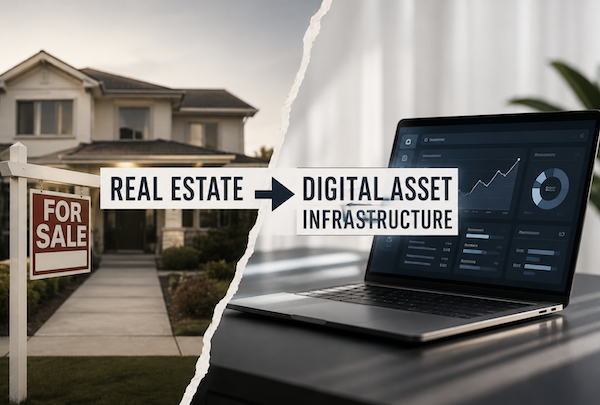
What “Digital Asset Infrastructure” Actually Means
The term gets thrown around loosely, so it’s worth defining precisely.
Digital asset infrastructure refers to income-producing systems that live online rather than on a plot of land: fully built and operated eCommerce storefronts, the supplier and fulfillment networks behind them, and the platform relationships (like Amazon Seller Central standing) that make the revenue possible.
Unlike a rental property, the “asset” isn’t the store’s inventory or a single SKU. It’s the operating system underneath it: sourcing relationships, account history, buy-box positioning, and the fulfillment infrastructure that keeps the store generating revenue month over month. The investor owns the account, the revenue stream, and the equity in that infrastructure, while a specialized operator runs the day-to-day.
That structure is what makes it comparable to real estate in the first place. A rental property is capital plus a tenant plus a management company. A managed digital asset is capital plus a customer base plus an operations team. Same shape, different infrastructure.
Real Estate vs. Managed Digital Assets: A Side-by-Side
| Factor | Real Estate | Managed Digital Asset (eCommerce) |
|---|---|---|
| Entry capital | Typically $100K+ with financing | Scalable starting points, often lower barrier to entry |
| Time to first yield | Months (renovation, tenant placement) | Weeks, once the store is built and sourcing is active |
| Ongoing time commitment | Property management oversight, repairs, tenant issues | Largely-passive once operations are handed to a managed team |
| Liquidity | Low; selling takes months | Higher; digital accounts can transfer faster than real property |
| Scalability | Requires new capital and financing per property | Can often scale within the same account infrastructure |
| Market exposure | Local market conditions, interest rates | Platform-level demand, less tied to local economic cycles |
Neither asset class replaces the other outright. The point isn’t “sell your buildings.” It’s that a portfolio built entirely on one illiquid, time-intensive asset class is a concentration risk, and digital asset infrastructure is one of the few alternatives that can produce comparable monthly distribution without asking for comparable hours.
Why This Shift Is Happening Now
Three forces are converging to make this a live conversation among capital-rich, time-poor investors:
1. Real estate yield compression. In many markets, cap rates have narrowed to the point where leveraged returns barely outpace the cost of capital. Investors who used to count on appreciation to cover the gap are re-underwriting their assumptions.
2. Platform infrastructure has matured. Amazon’s fulfillment, logistics, and seller-support systems are now mature enough that a professionally managed store can be built, sourced, and scaled without the investor ever touching operations. That wasn’t true a decade ago.
3. A generational shift in what “asset ownership” means. Younger high-income professionals in particular are less anchored to real estate as the only legitimate wealth vehicle. They’re comfortable owning equity in infrastructure they’ve never physically seen, provided the operating structure is transparent and the incentives are aligned.
What to Look for Before Allocating Capital
Diversifying into digital asset infrastructure only works if the operating structure is sound. Before allocating capital, investors should be able to answer:
- Who owns the account? The investor should hold direct ownership of the Amazon account and revenue stream, not a licensing arrangement.
- How is the operator compensated? A profit-split model, where the operator only earns when the asset produces yield, aligns incentives far better than a flat management fee.
- What’s the sourcing and fulfillment model? Understand exactly how inventory moves and who’s accountable at each stage.
- What’s the reporting cadence? Distribution and performance reporting should be as transparent as a property management statement.
Frequently Asked Questions
Is managed eCommerce infrastructure a good real estate alternative? It’s better understood as a complement than a replacement. Real estate offers tangible collateral and long-horizon appreciation; managed digital assets offer faster time-to-yield and lower time commitment. Investors seeking true diversification often hold both.
How much capital is typically needed to start? Requirements vary by operator and store model, but managed digital asset programs generally have a lower entry threshold than direct real estate acquisition, since there’s no property financing involved. Typical buy-ins for Amazon automation range from $25,000 to $80,000.
Is this the same as passive investing? It’s largely-passive. The investor isn’t running daily operations, but capital allocation, oversight, and understanding the business model remain the investor’s responsibility, the same way a real estate investor still needs to understand their market even with a property manager in place.
What makes this different from dropshipping or side-hustle content online? Scale and structure. A managed digital asset is built and operated by a dedicated team with sourcing infrastructure, account management, and a profit-split model, not a single individual running a side project. The investor owns real infrastructure and equity, not a task list.
The Bottom Line
Real estate isn’t going anywhere, and it shouldn’t. But treating it as the only serious path to cash-flowing assets is an increasingly outdated assumption. Digital asset infrastructure, when built on established platforms and operated by an experienced team, offers high-income professionals a way to put idle capital to work without adding another property to manage.
Elite Automation builds and operates done-for-you Amazon eCommerce assets for investors who want ownership and monthly distribution without becoming operators. If you’re evaluating where your next dollar of capital should go, explore how the model works.