By Katie Melissa
I read a lot of retail data for fun, which tells you something about how I spend my Saturday mornings. But the numbers that came out this spring made me stop scrolling. U.S. e-commerce sales grew nearly 10% year over year in the first quarter of 2026, the fastest quarterly growth rate since a pandemic-inflated Q1 2021. Online sales crossed $300 billion in a single quarter for the first time outside of a holiday period. E-commerce now makes up close to 24% of all U.S. retail spending, and every single month so far this year has stayed above an 18% online penetration rate, something that had only happened once before in the history of the data.
If you’re someone with capital parked in a savings account, a brokerage account that’s been flat, or equity in a primary business that already takes up all your time, this is worth pausing on. Not because it’s a hype cycle. Because it’s a structural shift in where consumer dollars are actually going, and it’s happening whether or not you personally participate in it.

The numbers behind the headline
Let’s get specific, because vague enthusiasm doesn’t help anyone make a decision. Total U.S. retail e-commerce sales in Q1 2026 came in around $302 billion, up from about $276 billion in the same quarter last year, according to Census Bureau data. That’s a growth rate close to double the pace of total retail sales in the same period. Online grocery alone grew more than 20% year over year, partly because same-day delivery windows have shrunk from same-day to, in some markets, under an hour.
Amazon remains the dominant force in that growth. It holds roughly 37.6% of U.S. e-commerce, more than six times the share of its nearest competitor. That’s not a company slowly losing ground to niche competitors. That’s a platform whose share of a growing pie has stayed enormous while the pie itself expands.
Here’s the part that matters most for anyone thinking about where to put money to work: this growth isn’t being driven by a handful of mega retailers building new warehouses. A meaningful share of it runs through third-party sellers on Amazon’s own marketplace infrastructure, independent stores using Amazon’s logistics, search traffic, and buyer trust to move product. Individuals and small teams are capturing real revenue inside a $300 billion quarterly wave, not by inventing something new, but by plugging into infrastructure that already exists.
Why this is a portfolio conversation, not a marketing sentence
I understand the instinct to be skeptical here. “E-commerce is growing” is the kind of sentence that shows up in a thousand pitch decks, most of which are selling something flimsy underneath the enthusiasm. So let’s separate the macro trend from the specific opportunity, because they’re not the same thing and treating them as identical is how people get burned.
The macro trend is real and independently verifiable through Census Bureau and Digital Commerce 360 data, not marketing copy. Online retail is capturing a larger share of consumer spending every year, and that share is not shrinking back. That part isn’t a bet. It’s already happened and it’s continuing to happen.
The specific opportunity, meaning whether a given store, operator, or structure will perform well, is a completely different question that depends on execution, not macro tailwinds. A rising tide doesn’t lift every boat. Poorly managed stores, whether run by an individual with no time or an outsourced team with no accountability, can lose money in a growing market just as easily as a shrinking one. Growth in the category creates the opportunity. It doesn’t guarantee the outcome for any one store, and nobody honest should tell you otherwise.
Where diversification actually fits
Most of the high earners I talk with already have exposure to real estate and equities, and a lot of them have most of their net worth concentrated in one operating business they built themselves. That’s a reasonable place to end up, and it’s also a concentrated bet on a single asset class or a single company’s fortunes.
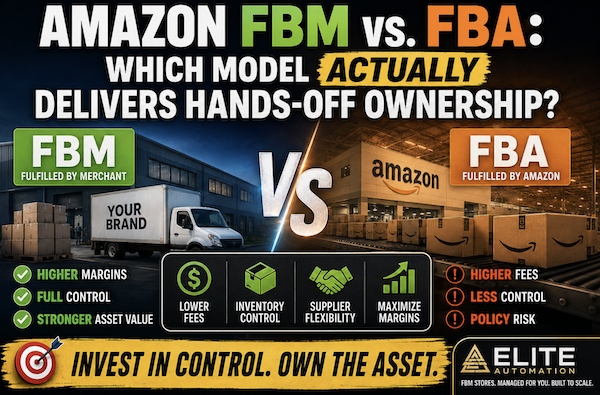
A managed Amazon FBM store is a genuinely different kind of asset. It’s not correlated to the stock market’s daily mood. It’s not another property that needs a property manager, a roof, and a mortgage rate you’re stuck with. It’s a digital asset built on top of consumer demand that’s currently growing faster than at any point in five years, operated day to day by a dedicated team rather than by you.
I want to be direct about the timeline, because I’d rather lose your interest than your trust. New stores typically don’t see consistent, meaningful sales until month four or later. Buy Box positioning, supplier relationships, and account health metrics all take real time to build, and anyone promising you fast returns is telling you what you want to hear, not what tends to happen. The Federal Trade Commission has been increasingly active in scrutinizing exactly these kinds of income claims in the automation and done-for-you space, and for good reason. If a business model can’t survive an honest timeline, it shouldn’t be sold with a dishonest one.
What you’re actually buying with a managed store is ownership of the account, the revenue stream, and the underlying asset, while a professional team handles sourcing, fulfillment, pricing, and account health day to day. You’re not becoming a seller. You’re becoming an owner who happens to sell through the fastest-growing retail channel in the country.
The window is open, not urgent
I’ll leave the urgency language to people who need you to decide today. You don’t. E-commerce isn’t going anywhere, and neither is Amazon’s position within it. But if you’ve had “diversify beyond stocks and real estate” on your list for a while and haven’t found a structure that doesn’t require you to become an operator, this is worth a real look, backed by real numbers, not a sales pitch dressed up as one.
If building additional cash flow through a professionally managed Amazon store sounds like something worth exploring for your own capital, Elite Automation’s team is happy to walk through what that structure actually looks like, what realistic timelines involve, and whether it fits where you’re at. No pressure, just a conversation with someone who does this for a living. You can schedule a call whenever it makes sense for you.