The Investor’s Guide to Amazon Automation Companies: Opportunities, Risks, and Reality in 2026
The dream of “making money while you sleep” has long been the holy grail of digital entrepreneurship. In 2026, this dream has found its most robust home in the e-commerce sector. As Amazon continues to dominate global retail, a specialized industry has matured to help busy professionals capture a piece of that pie: Amazon automation companies.
But is Amazon automation legit? And how do you navigate a landscape filled with both high-performing agencies and cautionary tales? This guide breaks down everything you need to know about the current state of passive income via Amazon FBA.
What is Amazon Automation?
At its core, Amazon automation (often referred to as “Store Management as a Service”) is a partnership. An investor provides the capital for inventory and service fees, while a professional agency handles the day-to-day operations of an Amazon store.
How does Amazon automation work? A reputable company typically manages a comprehensive suite of tasks to ensure the store thrives without the owner’s constant intervention:
- Product Research: Identifying high-demand, low-competition items using advanced data analytics and 2026 market trends.
- Sourcing and Logistics: Navigating global supply chains to get products into Amazon’s fulfillment centers efficiently.
- Listing Optimization: Writing SEO-driven copy and managing high-quality imagery to maximize conversion rates.
- Customer Service & Compliance: Handling returns and inquiries to maintain high account health scores and ensure alignment with Amazon’s Terms of Service (ToS).
For the investor, the goal is a passive income Amazon FBA stream that scales without requiring a 40-hour work week.
The 2026 Landscape: Best Amazon FBA Automation Services
The industry has moved away from the “dropshipping” models of the past, which often ran afoul of Amazon’s policies. Today’s leaders focus on sustainable business models like Wholesale and Private Label.
When researching Amazon automation companies, a few names frequently appear at the top of the SERPs for their specific operational strengths:
- Stores Automation: Known for multi-platform scaling and a robust logistics network that handles heavy volume.
- Elite Automation: Two step dropshipping and wholesale models designed to avoid tying up too much working capital at any given time.
- TechEcom: A technically-focused firm emphasizing high-margin replenishment and data-backed product selection.
- Mindsphere Consulting: Specialists in administrative compliance and ensuring long-term account health through rigorous customer service standards.
While these players offer various entry points, the most successful investors are looking for more than just a service provider—they are looking for a transparent partner.
Understanding the Models: Wholesale vs. Private Label
One of the most critical decisions when evaluating Amazon store management services is the underlying business model. Each carries a different risk-to-reward profile.
The Wholesale Model
In the wholesale model, an automation agency identifies established brands with high demand (e.g., household names) and secures permission to resell them on Amazon.
- The Benefit: Lower risk. You are selling products that already have a proven sales velocity and customer trust.
- The Careful Perspective: Margins are typically thinner because you are competing with other authorized sellers. Success here relies on the agency’s ability to secure exclusive or high-volume pricing through supply chain relationships.
The Private Label Model
Private Label involves creating your own unique brand. The agency finds a generic product, improves it, and brands it under your name.
- The Benefit: Higher margins and long-term brand equity. You own the “digital real estate” of that listing.
- The Careful Perspective: This requires more significant upfront capital for branding, customized manufacturing, and initial PPC (Pay-Per-Click) advertising to gain traction. It is a “higher-ceiling” play but requires a longer runway to reach profitability.
The Realities of Risk: A Balanced Perspective
While the potential for high Amazon automation returns on investment is real, it is vital to approach this space with a “risk-first” mindset. The Amazon marketplace is a dynamic environment, and success is never guaranteed.
1. Platform Dependency
Every Amazon business lives and dies by Amazon’s rules. A sudden change in the algorithm or a new policy regarding documentation can temporarily halt sales. A “careful” agency prioritizes account safety over aggressive, short-term growth.
2. Capital Requirements
Reputable Amazon store management services are not “get-rich-quick” schemes. They require significant upfront capital for inventory and operational fees. If a company promises high returns for a negligible investment, it is a major red flag—often a sign of an Amazon automation scam.
3. Market Volatility
Consumer trends shift. A product that is a bestseller in Q1 might see diminished margins by Q3 due to new competitors. Sustainable companies focus on building a diversified portfolio of products rather than relying on a single “hero” item.
How to Vet Amazon Automation Companies: Due Diligence
Before committing your capital, you must perform rigorous due diligence. Do not rely solely on marketing materials; look for concrete operational transparency.
- Direct Account Access: You should always own your Amazon Seller Central account. If an agency insists on holding the master credentials or “pooling” your funds into a shared account, walk away. You need 24/7 access to your data.
- Verified Client Results: Ask for case studies that show longevity. Anyone can have a lucky month with a trending product; look for stores that have maintained profitability for 12 to 24 months.
- Contractual Transparency: Avoid companies that “guarantee” specific percentages. E-commerce has too many variables for guarantees. Instead, look for partners who discuss realistic projections based on current market data and past performance.
- Physical Presence and History: Research the company’s physical office and executive team. The FTC has historically targeted “biz-op” scams that exist only as flashy websites. Ensure the company has a verifiable history and a team of real e-commerce professionals.
Choosing the Right Partner: Elite Automation
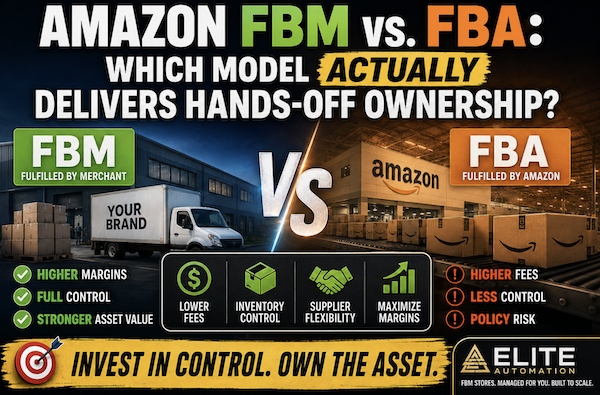
In an industry where transparency can be hard to find, Elite Automation has built a reputation on a “safety-first” philosophy. Unlike many Amazon automation companies that prioritize rapid scaling at the expense of account health, Elite Automation focuses on long-term brand equity and strict compliance with Amazon’s evolving guidelines.
By leveraging sophisticated supply chain relationships and data-driven product selection, Elite Automation helps investors navigate the complexities of Amazon automation vs. FBA automation nuances. They maintain a realistic, grounded approach to growth, emphasizing that in the world of e-commerce, the fastest way to grow is often by ensuring you never have to stop due to a policy violation.
The Bottom Line
Is Amazon automation a viable investment in 2026? Yes, but only for those who treat it as a serious business venture rather than a gamble. By understanding the operational realities and choosing a partner that values transparency over hype, you can build a resilient digital asset.
If you are ready to explore how a managed store can fit into your investment portfolio, start by asking the hard questions. A truly professional agency will be happy to provide the data you need to make an informed decision.