Amazon FBM vs. FBA: Which Model Actually Delivers Hands-Off Ownership?
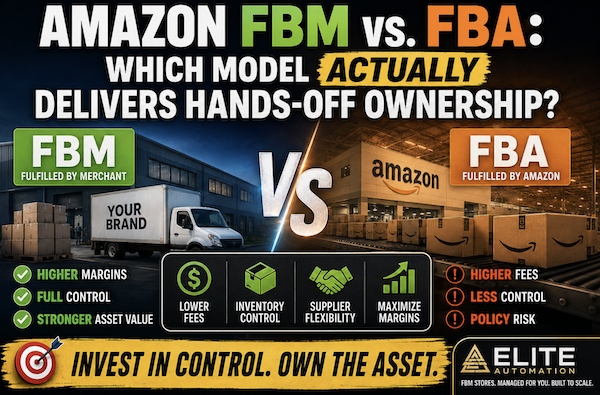
Amazon FBM and FBA are two different fulfillment structures, and the choice between them determines how much of an eCommerce store an investor actually owns versus how much they depend on Amazon’s internal systems. For an investor deciding how to allocate capital into a managed digital asset, FBM offers more control over the supply chain and a cleaner path to true ownership, while FBA offloads fulfillment to Amazon at the cost of margin and flexibility.
The Core Difference Between FBM and FBA
FBA (Fulfilled by Amazon) means Amazon stores, packs, and ships the inventory. The seller sends stock to Amazon’s warehouses and Amazon handles logistics from there.
FBM (Fulfilled by Merchant) means the seller, or the seller’s fulfillment partner, stores and ships the product directly. Amazon provides the marketplace and the customer, but the fulfillment infrastructure sits outside Amazon’s warehouses.
On the surface, FBA looks more automated since Amazon is doing the physical work. But that convenience comes with tradeoffs that matter to an investor evaluating this as an owned asset rather than a side project.
Why FBM Is the Stronger Model for Managed Ownership
| Factor | FBM | FBA |
|---|---|---|
| Storage fees | Paid to fulfillment partner, typically lower | Amazon storage and long-term fees, can escalate |
| Inventory control | Full visibility and control | Limited visibility once stock enters Amazon warehouses |
| Supplier flexibility | Two-step sourcing and scaling model available | Constrained by Amazon’s inbound requirements |
| Margin structure | Generally higher, fewer Amazon-side fees | Amazon takes a larger cut through fulfillment fees |
| Suitability for managed operation | Built for a dedicated ops team to run end to end | Often marketed as automated, but still exposed to Amazon policy shifts |
FBA is frequently marketed as the more “automated” option because Amazon physically touches the product. But automation of fulfillment is not the same as ownership of a managed asset. FBA sellers are still exposed to Amazon’s storage fee increases, inventory limits, and long-term storage penalties, all of which can erode the return an investor is expecting.
FBM, when run by an experienced operations team using a two-step sourcing and scaling model, gives the investor a cleaner asset. The account, the revenue stream, and the operating leverage stay under a structure the investor can actually understand and monitor, without Amazon’s warehouse logistics sitting in the middle of every decision.
What This Means for an Investor, Not an Operator
The distinction between FBM and FBA only matters at the mechanical level if you’re the one running the store. For an investor allocating capital into a managed digital asset, the real question is simpler: which model gives the operations team the most control to protect and grow the asset on your behalf?
FBM gives a management team more levers to pull. They can negotiate directly with suppliers, manage fulfillment costs, and respond to demand changes without waiting on Amazon’s warehouse constraints. That operational flexibility is what ultimately protects the investor’s monthly cash flow and the long-term resale value of the asset.
Frequently Asked Questions
Does FBM require more work from the investor than FBA? No. In a properly managed structure, the investor does not touch fulfillment under either model. The difference in workload applies to the operations team running the store, not the capital owner.
Is FBA safer because Amazon controls the logistics? Not necessarily. Amazon controls the warehouse, but the seller still bears the account health risk, the storage fee exposure, and the margin compression that comes with Amazon-side fulfillment costs.
Can a store switch between FBM and FBA later? Yes, some hybrid strategies use both. But for investors prioritizing margin and long-term control, FBM is typically the stronger foundation for a managed asset built to scale and eventually sell.
Which model has a better resale value? FBM stores with clean supplier relationships and consistent account health often command strong multiples, since the buyer is acquiring a more controllable and transparent operation rather than one fully dependent on Amazon’s internal systems.
Elite Automation builds and operates FBM stores using a two-step sourcing and scaling model, giving clients ownership of the account and the revenue stream while the operations team handles everything else. Book a discovery call to see how the model applies to your capital.