AI Shopping Agents Are Reshaping the 2026 Holiday Season. Here Is Who Wins.
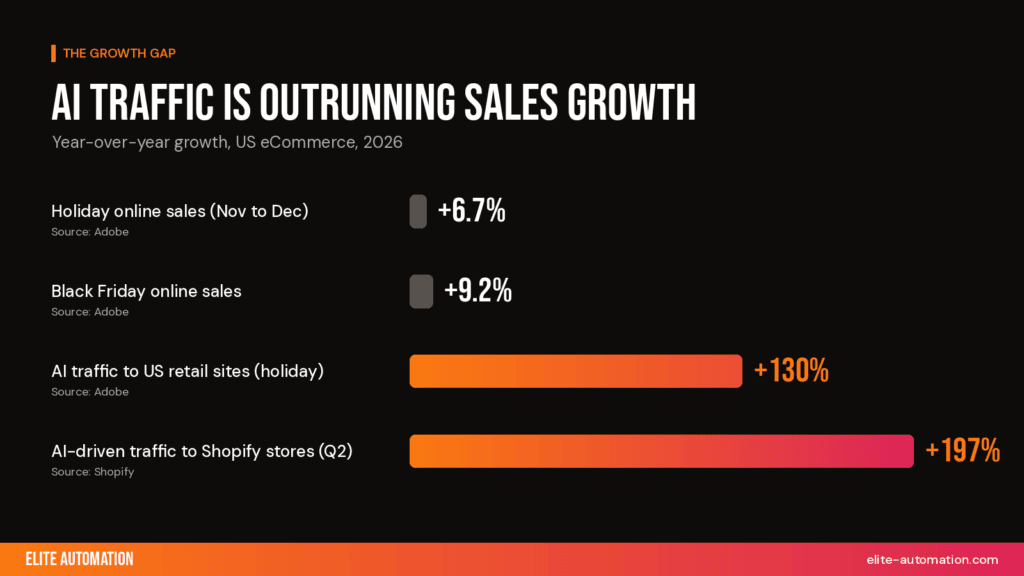
This holiday season, a growing share of shoppers will not browse at all. They will ask an AI agent to find the gift, compare the price, and in many cases complete the checkout. Adobe projects AI traffic to US retail sites will rise 130% year over year this season, while total online holiday sales grow 6.7% to a record $275.1 billion.
That gap is the story. Demand is growing steadily, but the way demand reaches a product is changing fast. For investors who own eCommerce assets, the question is no longer only “will people buy online?” It is “which infrastructure will the agents buy from?”
Key takeaways
- Record season: Adobe forecasts $275.1 billion in US online sales for November and December 2026 (+6.7%). Deloitte projects $316.1 to $318.9 billion for November through January (+7.5% to 8.4%).
- AI is the fastest-moving variable: AI traffic to US retail sites is projected to rise 130% this holiday season, and AI-driven traffic to Shopify stores rose 197% in Q2 2026.
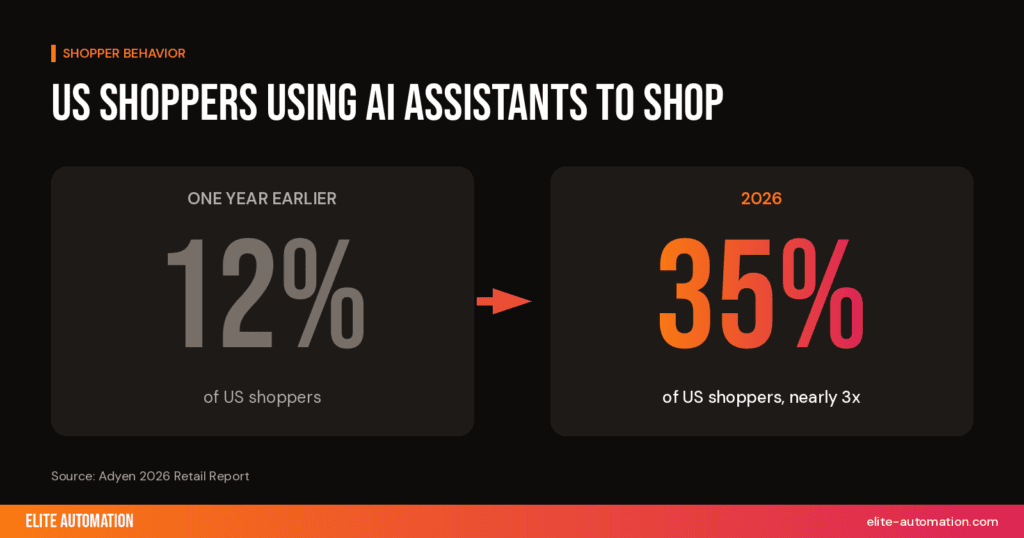
- Adoption nearly tripled: 35% of US shoppers now use AI assistants for shopping, up from 12% a year earlier (Adyen).
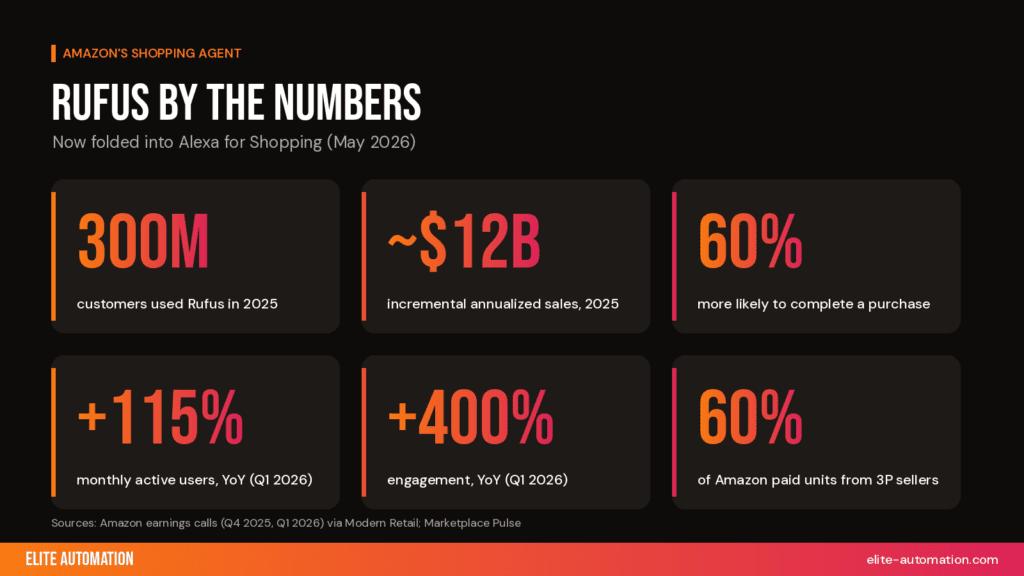
- Amazon built its own agent: Rufus, now part of Alexa for Shopping, drove nearly $12 billion in incremental annualized sales in 2025, and its users are 60% more likely to complete a purchase.
- Infrastructure wins: Agents reward structured data, stable pricing, reliable fulfillment, and trusted accounts. Those are operational disciplines, which is why professionally managed assets are positioned to capture this shift.
What is agentic commerce?
Agentic commerce is shopping that an AI agent researches, recommends, or completes on a person’s behalf. Instead of typing keywords and scrolling results, the shopper states a goal (“a cashmere scarf under $120 that arrives before December 20”) and the agent narrows the options, checks prices, and can place the order.
Three things changed in the past year that moved this from demo to revenue:
- Shared protocols arrived. OpenAI and Stripe released the Agentic Commerce Protocol (ACP) for checkout inside AI assistants, and Google launched the Universal Commerce Protocol (UCP) at NRF in January 2026 to cover the full journey from discovery to post-purchase.
- Retailers built their own agents. Amazon expanded Rufus with auto-buy at a target price, a full year of price history, and Buy for Me, then folded it into Alexa for Shopping in May 2026.
- Shoppers started trusting the answers. In an Adobe survey, 77% of people who used AI to shop said they felt more confident in their purchase, and 69% said they were less likely to return it.
It is still early. OpenAI paused its Instant Checkout feature in March 2026, and analysts note that the infrastructure is being built faster than consumer habits are changing. Long-range forecasts are large (McKinsey estimates AI agents could mediate $3 trillion to $5 trillion of global consumer commerce by 2030), but the near-term signal investors should watch is traffic and conversion, not headlines.
The 2026 holiday numbers: steady demand, explosive AI discovery
The headline forecasts point to a record but measured season. The AI numbers are where the acceleration lives.
| Metric (US, 2026) | Forecast | Growth YoY | Source |
|---|---|---|---|
| Online holiday sales, Nov 1 to Dec 31 | $275.1B | +6.7% | Adobe |
| Online holiday sales, Nov to Jan | $316.1B to $318.9B | +7.5% to 8.4% | Deloitte |
| Total holiday retail sales, Nov to Jan | $1.70T to $1.71T | +4.0% to 4.8% | Deloitte |
| Cyber Week online sales | $47.5B | +7.4% | Adobe |
| Cyber Monday online sales | $15B+ (record) | +6.2% | Adobe |
| Black Friday online sales | $12.9B | +9.2% | Adobe |
| October online sales | $95.8B | +8% | Adobe |
| Prime Big Deal Days (2 days, October) | Nearly $10B | Pre-season peak | Adobe |
| Buy now, pay later holiday spend | $21.3B | +6.6% | Adobe |
Two details matter for asset owners. First, Adobe expects shoppers to use deals to stock up on essentials, with Cyber Week sales of personal hygiene products up 150% and household cleaning up 49% versus September levels. Everyday, replenishable categories are exactly where agents with scheduled reorders and price alerts do their best work.
Second, October now matters. Adobe says Prime Big Deal Days has become an industry-wide shopping moment that pulls holiday demand forward, so a well-run store starts its season in early October, not on Black Friday.
Amazon’s agent: from Rufus to Alexa for Shopping
The largest AI shopping agent in the US already lives inside the largest marketplace. Amazon reported that Rufus was used by 300 million customers in 2025 and helped drive nearly $12 billion in incremental annualized sales. On its Q1 2026 earnings call, Amazon said Rufus monthly active users were up 115% and engagement up 400% year over year.
What the agent can now do, in plain terms:
- Auto-buy at a target price. A shopper sets a price, and the agent purchases when the listing hits it.
- Read a full year of price history. Shoppers can ask whether a product has ever been cheaper, and the agent can warn them to wait.
- Run scheduled tasks. Recurring restocks of household staples happen without a new search.
- Buy for Me. The agent can complete checkout on other retailers’ sites using the shopper’s Amazon address and payment.
In May 2026, Amazon folded Rufus into Alexa for Shopping, carrying one shopper profile across Amazon.com, the app, and Echo devices. Amazon also says customers who use Rufus are 60% more likely to complete a purchase. Higher intent at the moment of recommendation is the kind of traffic every store owner wants.
Why marketplace infrastructure is positioned to win
Agents favor places where trust, inventory, payment, and delivery are already solved. That describes established marketplaces far better than a standalone website starting from zero.
The evidence lines up:
- Shoppers trust retailer-built agents more. Bain survey data shows shoppers are three times more likely to trust retailer-built AI tools with their full shopping journey than general platforms like ChatGPT.
- Open-web checkout is still uneven. OpenAI paused Instant Checkout in March 2026, while Amazon’s agent completes purchases inside an ecosystem with saved payment, Prime delivery, and an A-to-z guarantee.
- Independent sellers still carry the marketplace. Third-party sellers accounted for 60% of paid units on Amazon in Q1 2026. That share dipped from a 62% peak as Amazon’s own retail and grocery grew, but third-party unit volume is still rising in absolute terms.
- Amazon is investing heavily in the rails. The company planned about $200 billion in 2026 capital expenditures, mostly on AI infrastructure, and its advertising revenue grew 24% to $17.2 billion in Q1.
The honest caveat: the share dip means more competition from Amazon’s own retail on some listings, and AI agents compress the margin for sloppy operators. Agents compare prices, read a year of history, and steer shoppers away from erratic pricing. A store that is not run professionally will feel that pressure first.
That is the core reason the agentic shift favors managed assets over do-it-yourself stores. The work that wins agent recommendations is operational, daily, and unglamorous.
What this means for owners of managed eCommerce assets
For a capital-rich, time-poor investor, agentic commerce is good news with one condition: the asset has to be operated well. An AI agent does not care who owns the store. It cares whether the listing is clear, the price is fair and stable, the item ships on time, and the account is trusted.
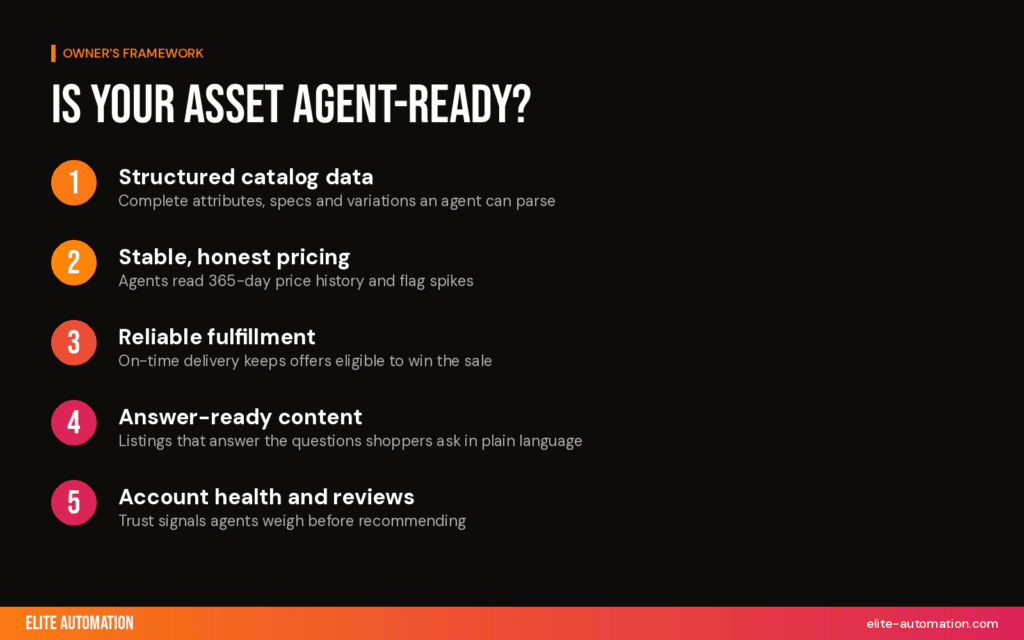
Here is how each point maps to the work behind a managed digital asset:
- Structured catalog data. Agents parse attributes, not marketing copy. Complete specs, variations, and categories make a product eligible to be recommended at all.
- Stable, honest pricing. With a full year of price history visible, aggressive swings can trigger a “wait for a better price” prompt. Disciplined repricing protects conversion.
- Reliable fulfillment. Agents complete purchases where delivery is predictable. Supplier scaling and order monitoring keep offers eligible during peak weeks.
- Answer-ready content. Listings should answer the questions people actually ask an agent, in plain language: size, compatibility, what is in the box, delivery timing.
- Account health and reviews. Performance metrics and customer feedback are the trust signals that decide whether an agent recommends a store or skips it.
At Elite Automation, this is the daily operating work behind every client asset. We build and run Amazon FBM stores on Amazon’s infrastructure, handling sourcing, fulfillment, account management, and scaling, while the client owns the Amazon account, the revenue stream, and the asset. A profit-split model keeps our incentives aligned with the owner’s yield.
The practical takeaway: you do not need to become an operator to benefit from AI-driven commerce. You need an asset that is run like the agents are watching, because increasingly, they are.
Frequently asked questions
What are AI shopping agents?
AI shopping agents are AI systems that research products, compare prices, and can complete purchases on a shopper’s behalf. Examples include Amazon’s Alexa for Shopping (formerly Rufus), ChatGPT shopping features, and Google’s agentic checkout tools.
How much will AI affect 2026 holiday shopping?
Adobe projects AI traffic to US retail sites will rise 130% year over year during the 2026 holiday season, while total US online holiday sales grow 6.7% to $275.1 billion.
How many shoppers use AI to shop?
According to Adyen’s 2026 Retail Report, 35% of US shoppers use AI assistants for shopping, up from 12% a year earlier.
Does Amazon’s AI assistant increase sales?
Amazon reports that Rufus drove nearly $12 billion in incremental annualized sales in 2025 and that customers who use it are 60% more likely to complete a purchase. These are Amazon’s own estimates.
Will AI agents replace Amazon stores?
Current evidence points the other way. Shoppers are three times more likely to trust retailer-built AI tools than general platforms (Bain), and Amazon’s own agent recommends and buys within its marketplace. Well-operated marketplace stores are positioned to benefit.
How can an investor benefit without running a store?
One option is a fully managed eCommerce asset: the investor owns the account and revenue stream while an operator handles sourcing, fulfillment, pricing, and account health. Results vary by store, product category, and market conditions, and returns are never guaranteed.
Own the asset. Let us run it.
The shift to AI-driven shopping rewards operators who get the details right every day. If you have capital to deploy and want exposure to eCommerce cash flow without taking on another job, book a strategy call with Elite Automation to see how a managed, cash-flowing eCommerce asset could fit your portfolio.
Disclosure: This article is for informational purposes only and is not financial, investment, or legal advice. Forecasts cited are third-party projections and may not materialize. Elite Automation does not guarantee any level of revenue or profit. Individual results vary based on capital, product category, marketplace conditions, and other factors.
Sources
- Retail Dive: Adobe 2026 holiday online sales forecast (Sept 28, 2026)
- Chain Drug Review: Deloitte 2026 holiday forecast
- MarketScale: Deloitte holiday eCommerce forecast (Sept 18, 2026)
- Modern Retail: Amazon Rufus users up 115% (Apr 30, 2026)
- EcomCrew: Rufus auto-buy, price history, and Bain trust data
- Presenc AI: Alexa for Shopping statistics (Sept 2026)
- Marketplace Pulse: Amazon third-party unit share, Q1 2026
- Ask Phill: Adyen 2026 Retail Report AI shopper data
- Ringly: Shopify AI traffic and McKinsey agentic commerce estimate
- Paz.ai: Agentic commerce protocols timeline
- EMARKETER: Takeaways from Shoptalk 2026